Abstract
Key Contributions
- A novel two-stage weakly supervised anomaly detection (WSAD) framework that operates using only slice-level labels.
- A prompt-tuning strategy (DDPT) to generate high-quality pseudo-masks from slice level supervision using vision-language models.
- A Region-Aware Spatial Attention (RASA) mechanism guided by Location-based Random Embeddings (LoRE) to effectively capture local contextual dependencies.
- Superior performance while significantly reducing the number of model parameters (~7.8M) compared to existing methods.
Method Overview
Our approach consists of two stages: (1) Discriminative Dual Prompt Tuning (DDPT) for generating pseudo weak masks, and (2) RASALoRE segmentation network for precise anomaly localization.
Stage 1: Discriminative Dual Prompt Tuning (DDPT)
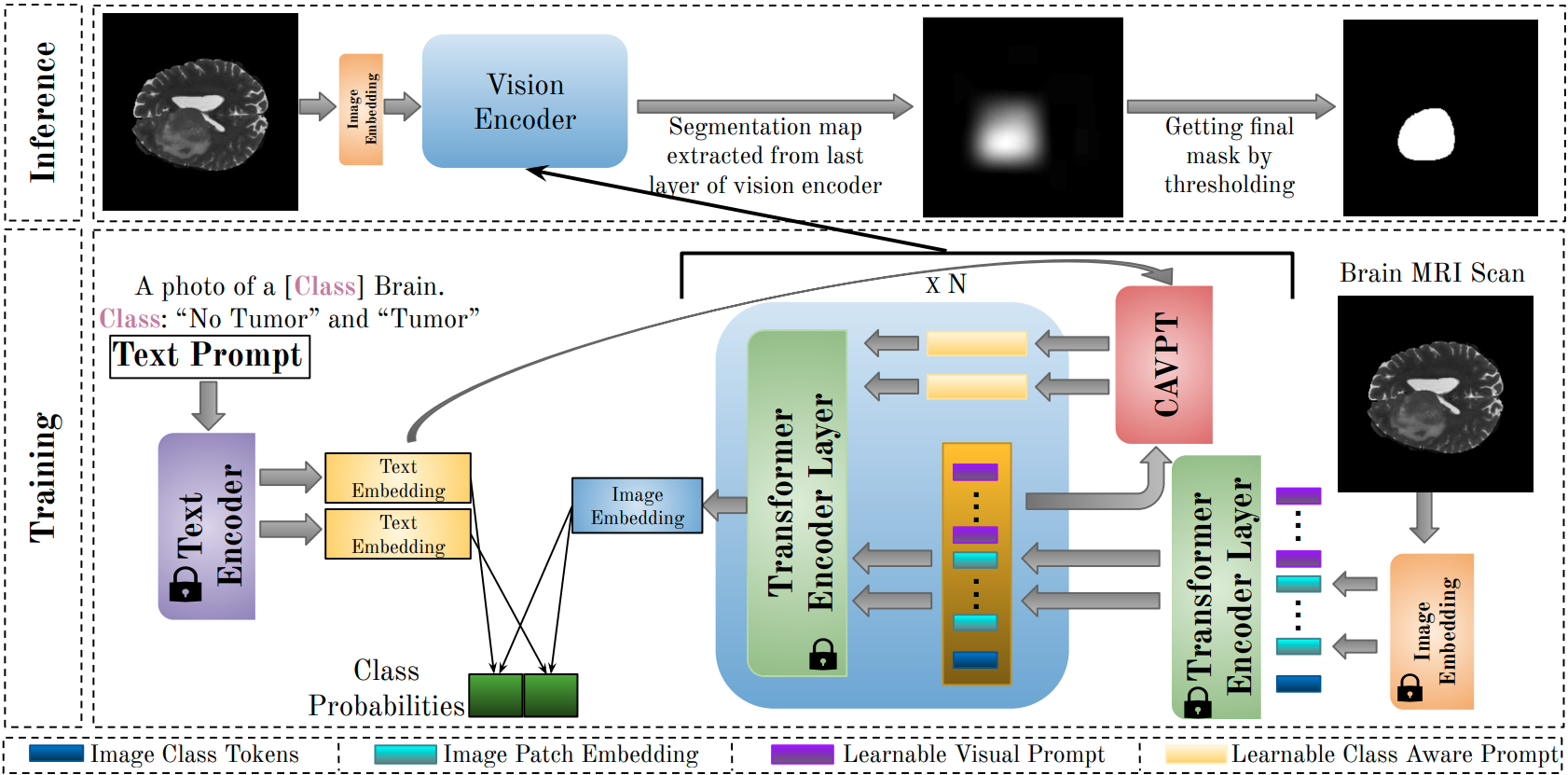
DDPT employs a classification-driven approach to generate coarse anomaly segmentation maps using only weak (slice-level) supervision. By training a discriminative network to classify brain MRI scan images, we extract attention maps that contain potential region localization information.
Stage 2: RASALoRE Architecture
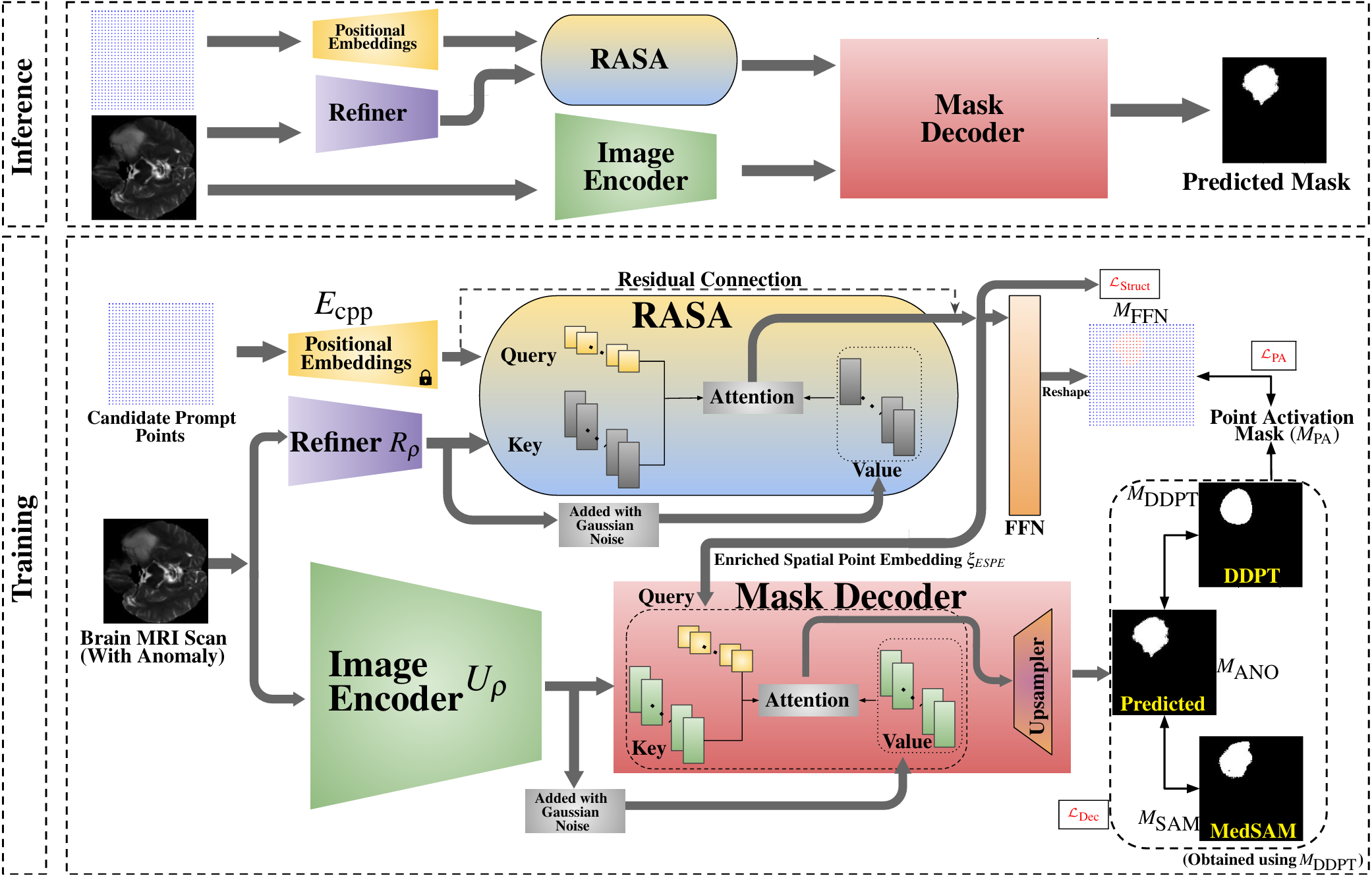
Location-based Random Embeddings (LoRE): We generate a grid of evenly spaced Candidate Prompt Points (CPPs) across the input image. Each CPP receives fixed, non-learnable random embeddings based on sinusoidal transformations, independent of dataset-specific biases.
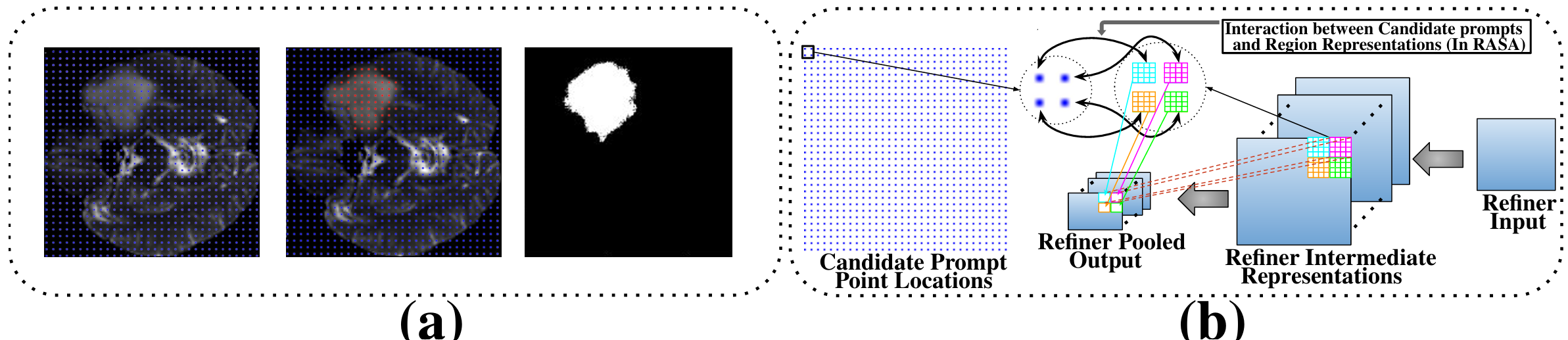
Region-Aware Spatial Attention (RASA): RASA enables interaction between location embeddings and spatial information through multi-head attention, where CPP embeddings form the query, and refined image representations provide key and value components. This allows the model to effectively focus on anomalous regions.
Results
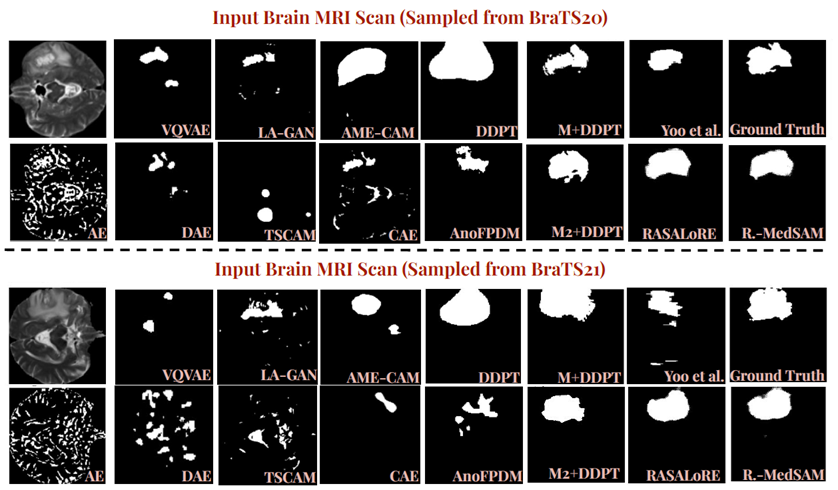
Visual analysis reveals that RASALoRE achieves sharp boundaries and accurate localization across diverse tumor morphologies, significantly outperforming reconstruction-based and CAM-based approaches on BraTS20, BraTS21, BraTS23, and MSD datasets.
Key Features
- Parameter Efficiency: Less than 8 million parameters (~7.8M)
- Weakly Supervised: Operates using only slice-level labels
- Fixed Random Embeddings: Non-learnable location-based embeddings independent of dataset biases
- Region-Aware Attention: Effectively captures local contextual dependencies
- Multimodal Extension: Successfully extends to multiple MRI modalities (T1, T1ce, FLAIR)
Acknowledgments
We gratefully acknowledge Technocraft Centre of Applied Artificial Intelligence (TCAAI), IIT Bombay for their support through generous funding.